Stress Signals You’re Missing: Why Doubling Down Makes Your Career Worse
When work gets hard, the default response for many ambitious professionals is simple: push harder. Stay later. Take on more. Prove your worth. Operate on less sleep and call it resilience.
That approach can look impressive for a while. But constantly doubling down is often how temporary stress becomes chronic burnout. The real cost shows up quietly in your energy, focus, motivation, relationships, health, and ability to do your best work over the long term.
Resilience is not about becoming a machine. It is about being able to experience stress, adapt to it, recover from it, and continue moving forward without abandoning yourself in the process.
Key Takeaways
- Resilience means adapting to stress, not suppressing emotion or powering through exhaustion.
- Sleep, hydration, food, movement, rest, and novelty create the foundation for emotional regulation.
- ADHD and anxiety can support hyperfocus and problem-solving while complicating routine tasks and attention.
- Lasting improvement comes from supportive systems, not blaming yourself for how your brain works.
Table of Contents
- Resilience Is Not Grit, Stoicism, or Perfectionism
- There Is No Perfect Balance, but There Are Strong Foundations
- Stop Relying on Cognitive Resources Alone
- The Gap Between Knowing and Doing
- ADHD and Anxiety: Superpowers and Kryptonite
- Build Systems Instead of Blaming Yourself
- A More Sustainable Definition of Career Success
Resilience Is Not Grit, Stoicism, or Perfectionism
High achievers often confuse resilience with grit. They think resilience means powering through a demanding weekend, accepting every urgent request, or finishing the project no matter what it costs.
But grit without limits can become workaholism. The people who continuously force themselves through exhaustion are often the ones who become more stressed, crash harder, and struggle longer to recover.
Another common misconception is that resilient people are stoic. They never show emotion, never get overwhelmed, never make mistakes, and always seem fine. That standard creates a dangerous form of perfectionism: the belief that having normal human reactions is somehow a failure.
Real resilience is not suppressing emotion. It is feeling what you feel, acknowledging it, coping with it, and still doing what matters.
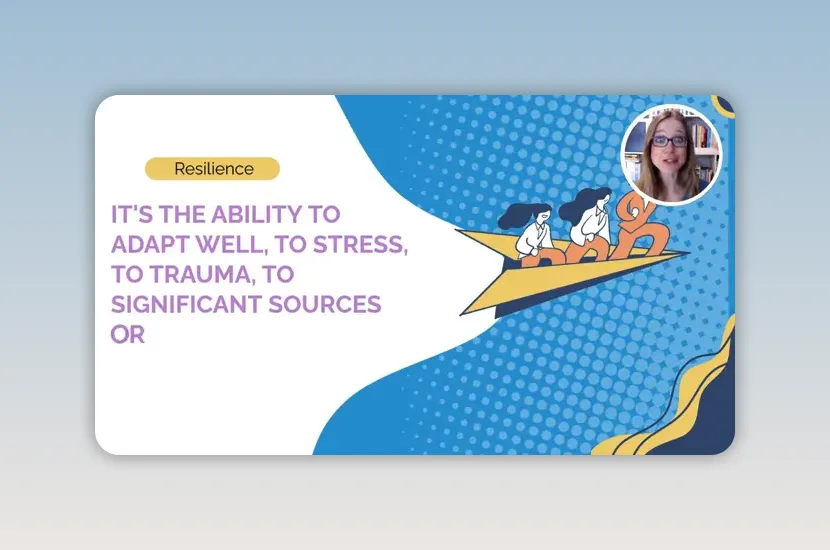
Resilience is the ability to adapt well when stress, trauma, or adversity show up.
Stress is part of resilience because resilience requires something to adapt to. The aim is not a stress-free life. The aim is flexibility: the capacity to adjust when the world changes and when circumstances are outside your control.
Distress tolerance is a career skill
A major part of resilience is distress tolerance. That means being able to sit with uncomfortable feelings rather than immediately reacting to them.
At work, distress tolerance can look like:
- Receiving corrective feedback without becoming defensive or blaming others.
- Hearing a different opinion without needing to win the argument.
- Recognizing mistakes as information rather than evidence of personal failure.
- Asking, “How can I do a little better tomorrow?”
The most successful people are not necessarily the people who avoid feedback. They are often the people actively looking for it because they want to learn, improve, and make the next attempt better.
There Is No Perfect Balance, but There Are Strong Foundations
We talk a lot about balance, but life does not always feel balanced. Sometimes a project, family responsibility, or major goal genuinely needs more of your attention for a period of time.
The more useful question is this: What foundations make you more capable when stress hits?
These are the “setting events” that influence how much resilience you have available. Think of them as the conditions that charge or drain your resilience battery, executive functioning battery, and self-regulation battery before the difficult moment even arrives.
Your response to stress is shaped long before the stressful moment begins.
Sleep is not a badge of honor to sacrifice
Sleep is one of the first things ambitious people cut, usually while insisting they can handle it. But lack of sleep drains the cognitive and emotional resources needed for judgment, focus, self-control, and recovery.
Willpower is not an endlessly reliable resource. If you are exhausted, trying to “just be disciplined” asks too much from a system that is already depleted.
Instead of treating short sleep as proof of commitment, treat sleep as performance infrastructure. The goal is not to force an arbitrary number of hours. It is to understand what supports your own recovery and establish more consistency.
One practical place to begin is with a regular wake-up time. Sleeping in dramatically on weekends may feel restorative in the moment, but constantly shifting your schedule can make your brain feel as though it is repeatedly adjusting to jet lag.
Hydration, food, movement, and novelty matter
Resilience is not built entirely in your head. You are a biological being, and the basics make a difference.
- Hydration: Dehydration can increase physiological stress responses. Make water easy to reach by keeping it visible and available in the environments where you work.
- Regular food: Your brain needs fuel. When you go long stretches without eating, focus and emotional regulation become harder.
- Movement: Exercise and regular movement help create a stronger foundation for managing stress.
- Breathing practice: Long exhalations can be useful when practiced proactively throughout the day, rather than only attempting them in a moment of high distress.
- Novelty and enjoyment: Brains need stimulation and variety. Try something different, whether that is roller skating, bowling, a new activity, or time in nature.
It is much harder to regulate yourself in the middle of a crisis if you have neglected every foundation leading up to it.
Make hydration the easy choice by placing water where you already spend time.
Stop Relying on Cognitive Resources Alone
Many high achievers try to solve stress with more thinking, more planning, and more mental force. But cognitive resources are often the worst thing to rely on when they are already depleted.
When you are under-slept, under-fueled, overwhelmed, and overextended, your brain has less capacity for the exact skills work demands: prioritizing, focusing, remembering, initiating tasks, regulating emotion, and making decisions.
This is why the “push harder” response can backfire. You may be working more hours while becoming less effective in those hours.
Breaks are not a detour from productivity
Rest and breaks can feel unproductive when there is a lot to do. But sustained output does not come from draining the battery to zero. It comes from managing the battery well enough to keep going.
Consider studying for a major exam. Trying to cram an entire course into your mind the night before is like trying to force a bathtub full of water through a tiny spout. The system gets overwhelmed, and much of what you attempt to force in spills over.
The better approach is smaller amounts over time. The same is true for complex work, skill-building, creative problem-solving, and recovery. Small, consistent inputs are more sustainable than repeated all-out sprints.
The Gap Between Knowing and Doing
Most of us know the basics. We know sleep matters. We know breaks help. We know movement, water, food, and boundaries are useful.
The harder question is: What gets in the way of doing what you already know?
This is where the “yeah, but” shows up.
- “Yeah, but I do not have time.”
- “Yeah, but this project is too important.”
- “Yeah, but everyone else is working late.”
- “Yeah, but I need to prove I can handle it.”
Those obstacles need to be named clearly. Once you know the barrier, you can create a plan around it rather than relying on intention alone.
Do not begin by trying to overhaul everything at once. Find one manageable action. Set a wake-up time. Put a water bottle at your desk. Take a real break between demanding tasks. Move your body for a few minutes. Build from there.
ADHD and Anxiety: Superpowers and Kryptonite
ADHD and anxiety can create a real double-edged sword in professional life. The qualities that make someone exceptional in the right setting can also become deeply frustrating when the environment or task does not fit.
ADHD strengths often emerge when work is interesting, challenging, and personally meaningful.
When ADHD becomes a strength
When someone with ADHD is engaged in work they enjoy and care about, their nervous system can become highly stimulated by challenge and interest. This can create intense hyperfocus and the ability to accomplish a huge amount in a short period.
ADHD and anxiety can also contribute to strong pattern recognition, rapid problem-solving, and sensitivity to environmental cues. In complex situations that confuse others, a highly alert mind may spot possibilities, risks, or solutions quickly.
There is also the principle often described as Parkinson’s law: work tends to expand to fill the time available. People with ADHD may be especially capable of mobilizing under urgency and delivering when a deadline creates enough stimulation.
When the same traits become a barrier
The difficulty arises when a task feels repetitive, boring, externally imposed, or disconnected from personal meaning. A person can be brilliant at solving a complicated problem, then struggle to answer an email, submit an expense report, check accounts payable, or complete taxes.
This is not a measure of intelligence or resilience. It is often a mismatch between the task and the systems available to support task completion.
Anxiety can create another challenge. Sensitivity that helps someone notice details may also become a constant false alarm. When the nervous system is on edge, focusing on work becomes harder because attention is being pulled toward perceived threats.
Build Systems Instead of Blaming Yourself
At work, you may not control your manager, your workload, or the way success is measured. You may feel like a fish being judged on its ability to climb a tree.
That is frustrating, but there is still room for action. The starting point is awareness: identify the stressors and identify the specific tasks where things tend to break down.
Maybe you consistently forget an item mentioned during a meeting. Maybe your email becomes unmanageable. Maybe a task is not difficult, but it disappears from your mind the moment it is no longer visible.
The answer is not to call yourself lazy, incapable, or unintelligent. The answer is to find the right systems.
Success is not only about trying harder. It is about designing systems that support how you actually work.
Supportive systems can include:
- Writing down action items immediately during meetings.
- Using reminders, checklists, calendars, and visible cues.
- Breaking large tasks into small, concrete next steps.
- Creating routines for tasks that are easy to forget.
- Reducing unnecessary friction in the environment.
- Keeping helpful resources, such as water, notes, or task lists, where you can see them.
This is not about forcing yourself to function like someone else. It is about creating conditions that make success more likely for you.
A More Sustainable Definition of Career Success
Working harder is not always the same thing as working better. Being the first person in the office and the last one to leave is not automatically a sign of resilience. Operating on four hours of sleep is not a professional identity to aspire to.
Sustainable success comes from awareness, recovery, flexibility, and intentional action. It comes from noticing the early stress signals before they become a crisis.
If your focus is slipping, your patience is thin, ordinary tasks feel impossible, or your motivation has disappeared, do not automatically interpret those signals as evidence that you need to double down.
Pause long enough to ask better questions:
- What is draining my resilience battery right now?
- Which basic needs have I been treating as optional?
- What is my “yeah, but” obstacle?
- What system would make this task easier to complete?
- What small action would make tomorrow more manageable?
Resilience is not about becoming harder. It is about becoming more adaptable, more self-aware, and more supported by the systems and habits around you.