Girls Who CEO Teen Presentation Brain Hack That Helps You Stay Calm Under Pressure
You can have a brilliant idea, a strong strategy, and a deck full of smart insights, then lose access to all of it the second pressure hits.
If you lead in a tech company, you have seen this happen everywhere. A new manager freezes in a quarterly business review. A high potential engineer goes blank during a stakeholder presentation. A product lead becomes defensive in a roadmap meeting and starts fighting the room instead of solving the problem.
What looks like a confidence problem is often a brain state problem.
That distinction matters, especially if you are investing in employee development. When people understand what is happening inside them under stress, they gain something more valuable than a one time performance tip. They gain a repeatable way to steady themselves, think clearly, and lead well.
This simple brain hack explains why people fight, flee, or freeze under pressure, and what to do to return to a calmer, more capable state.
Why smart people can look unprepared under pressure
Start with a simple image. Think about a lizard or a chameleon.
When something large and threatening comes near it, it does not stop to analyze options or write a pros and cons list. It hides, runs, or reacts quickly to protect itself. If the threat seems smaller, it may attack. Its response is fast, instinctive, and built for survival.
Humans do something similar.
Under stress, you can slip into a fast protective mode that pushes you toward three familiar reactions:
Fight, where you argue, push back, or come out swinging
Flight, where you avoid, shut down, or want to escape
Freeze, where your mind stalls and your body feels stuck
That is the core idea behind the so called lizard brain concept. It is a simple model, not a perfect scientific label, but it is useful because it helps you understand behavior quickly.
And once you can name the pattern, you can work with it.
Fight, flight, and freeze show up at work more often than you think
These reactions are not just for physical danger. In modern work, your brain can read social or professional pressure as threat too.
That is why people react strongly in moments that do not seem dangerous on the surface.
Fight in the workplace
You have probably seen this one in a product review or postmortem.
An engineer gets challenged on an estimate and responds with sharp defensiveness. A director hears feedback on team morale and starts justifying every decision instead of listening. A founder in a board prep meeting interrupts everyone because uncertainty feels unbearable.
It looks like ego. Sometimes it is. But often it is threat response dressed up as confidence.
Flight in the workplace
This one is quieter and easier to miss.
A talented employee keeps postponing a big presentation. A manager avoids a hard conversation with a low performer for weeks. A new executive delegates every high stakes narrative moment to someone else because stepping into the spotlight feels too risky.
No one is literally running down the hallway, but the nervous system is still trying to get away.
Freeze in the workplace
This is the one many leaders underestimate.
Freeze can feel like wanting to move and not move at the same time. You know you should say something, but no words come. You know the answer, but your mind suddenly feels empty. You are not calm. You are jammed.
That can happen to a teenager in a classroom, and it can happen to a senior vice president in front of the executive committee.
If you have ever watched a sharp employee go blank during a launch review and thought, “That is not like them,” this is exactly the kind of moment you are looking at.
Why this matters so much for leaders
If you are leading people, this is not a soft skill side note. It is operationally important.
Leaders make decisions that affect budgets, priorities, careers, and families. In a tech company, that can mean:
Choosing whether to fund a platform migration
Handling a customer escalation that could affect renewal revenue
Responding to a security incident with speed and clarity
Giving performance feedback that shapes someone’s confidence for years
Presenting strategy when the company needs calm, not panic
When people are trapped in fight, flight, or freeze, they are usually not thinking with their best judgment. Their decision quality drops. Their listening narrows. Their emotional range shrinks. Their ability to connect with others weakens.
That is why understanding stress response is part of leadership development, not separate from it.
The goal is not to eliminate stress
Here is the part many organizations miss.
You do not want people to be relaxed all the time. That would be unrealistic and, in some situations, unhelpful.
Protective responses exist for a reason. If a real threat appears, fast reaction can help you. The problem is not that fight or flight exists. The problem is getting stuck there when the danger has passed, or when the challenge is simply a meeting, presentation, or difficult conversation.
The real skill is learning how to return to what you might call a free state. That is the state where you feel safe enough to think clearly, respond intentionally, and use your strengths.
In that state, you are more likely to:
Speak with clarity instead of urgency
Listen without becoming defensive
Make stronger decisions
Present with steadiness
Lead yourself before trying to lead others

Two simple ways to activate a calmer state
When you feel anxious, overwhelmed, or frozen, two practical tools can help you shift out of stress mode and back into a more grounded state.
1. Use a self hug to create a sense of safety
Think about what children often do when they are scared. They move toward a parent, a loved one, or someone safe. The body is looking for reassurance and containment.
When support is not immediately around you, you can create a version of that signal yourself.
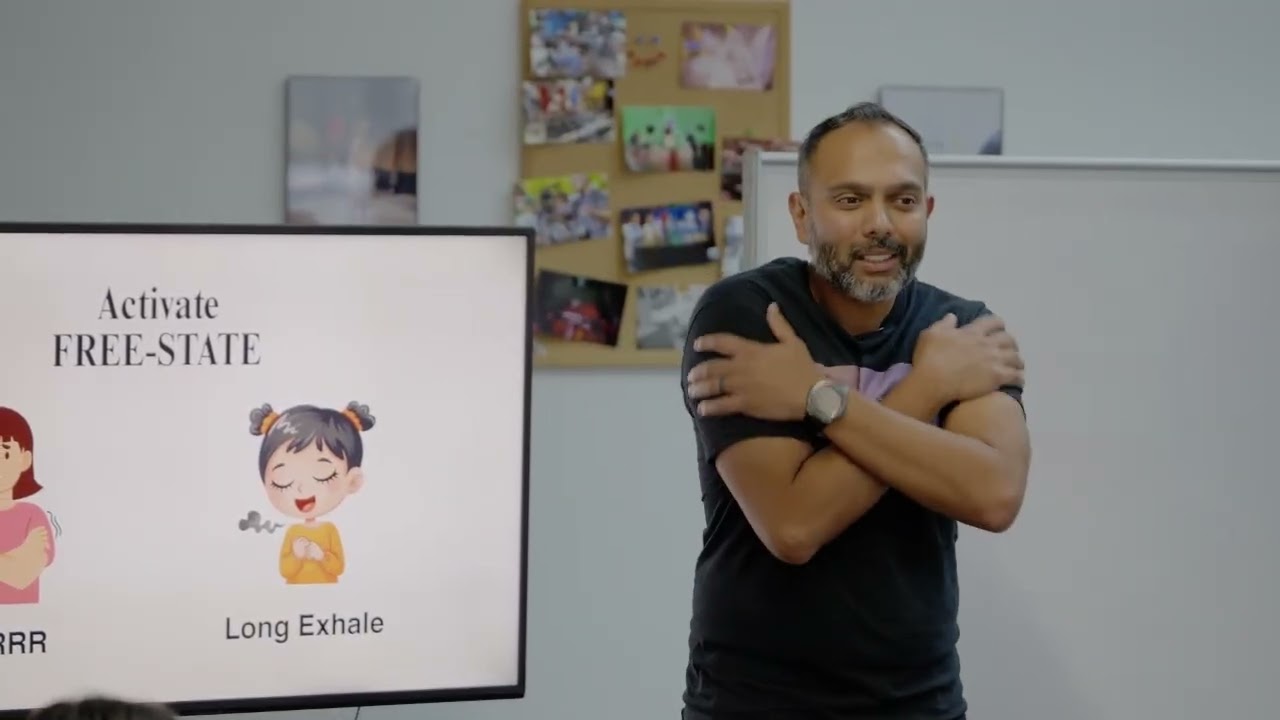
Cross your arms around your body in a gentle self hug, almost like you are cold. That physical cue can help settle your system and remind you that you are here, you are safe, and you can steady yourself.

It may sound simple. That is exactly why it works so well in real life. You can do it discreetly before a presentation, after a hard message from your boss, or during the few seconds between a difficult question and your answer.
In a tech setting, this can be useful when:
You are about to present an architecture decision to a skeptical cross functional group
You just received surprise questions from the CFO on headcount planning
You are preparing to deliver tough feedback to a strong but struggling team member
2. Focus on the exhale, not just breathing in
Many people hear “take a breath” and assume the magic is in inhaling deeply. The more useful focus here is the long exhale.
Think about what happens when you brace for something and then realize it is okay. Your body naturally releases. You breathe out longer. That extended exhale is one of the ways your system signals relief and safety.
You can use that on purpose.
When anxiety rises, breathe out slowly and fully. That long exhale can help nudge your brain and body toward a calmer state.

This is especially helpful before high pressure communication moments such as:
A customer call after an outage
A board meeting rehearsal
A promotion panel interview
A demo where too much is riding on one moment
If you want a broader grounding reference on breath and regulation, the overview of breathwork from Psychology Today is a useful starting point.
What to do in the moment when nerves hit
When you notice your stress response kicking in, do not shame yourself for it.
That only adds a second problem to the first.
Instead, walk yourself through a short reset:
Name the state. Ask yourself if you are fighting, fleeing, or freezing.
Reduce the threat signal. Remind yourself that this is pressure, not danger.
Use the self hug if needed. Create a physical cue of safety.
Take a long exhale. Let the body release.
Re enter with intention. Speak more slowly. Listen longer. Answer the next question, not every imagined one.
This matters because in tense moments, your team often borrows emotional cues from you. If you regulate yourself, you increase the odds that the room regulates with you.
Practice when you are calm, not only when you are stressed
One of the smartest questions you can ask is this: if these tools help in pressure, should you use them only when pressure shows up?
No.
The real power comes from repetition.
If you practice the long exhale and the self calming routine only during stressful moments, you will have to remember a new skill while already dysregulated. That is hard.
But if you practice while calm, the response becomes more natural. It starts to feel less like a technique you are forcing and more like an instinct your body recognizes.
That is true for communication skills, and it is true for nervous system regulation. Repetition builds access.
In other words:
Practice before you need it
Repeat until it feels familiar
Use calm moments to prepare for high stakes ones
This is no different from leadership rehearsal in other areas. You do not wait for a production incident to decide how your escalation path works. You do not wait for a board meeting to discover whether your story holds together. And you should not wait for panic to learn how to calm yourself.
How senior leaders can apply this in employee development
If you are investing in talent, this is where the idea becomes practical.
Too many development programs focus only on content delivery. Better slides. Better executive presence. Better storytelling. Those matter, but they are incomplete if the person presenting cannot stay regulated under pressure.
To build stronger communicators and future leaders in a tech company, teach both:
Message discipline, so people know what to say
State management, so they can actually access what they know
That can look like:
Teaching new managers what fight, flight, and freeze look like in meetings
Adding calming routines before presentation training sessions
Normalizing nerves instead of treating them as weakness
Encouraging team members to ask for help early
Helping employees build repeatable practices before major presentations
There is a bigger leadership message underneath all of this. People do not just need instruction. They need tools that help them return to themselves when pressure tries to take that away.
For additional context on how stress affects decision making and performance, the Harvard Business Review library is a strong resource for leadership teams shaping talent strategy.
Do not forget the simplest leadership habit of all
If help is available, ask for it.
That point is easy to skip because it sounds obvious. It is not obvious in practice.
High performers often assume they should be able to handle everything on their own. Rising leaders do this all the time. They think asking for support will make them look less capable, when in reality it often shows maturity.
Sometimes the strongest thing you can teach a future leader is this: regulate yourself when you can, and reach for support when you need it.
That is not dependence. That is wisdom.
The real opportunity for admired leaders
If others look up to you, your influence is larger than your title.
You shape what pressure feels like on your team. You shape whether people hide their nerves or learn to work with them. You shape whether employee development is just about technical excellence or about developing whole humans who can think, speak, and lead under strain.
And in this era of constant change, that may be one of the best investments you make.
Teach your people how the brain reacts under pressure. Give them a shared language for fight, flight, and freeze. Help them practice the self hug and the long exhale before the next big moment arrives.
Because sometimes the difference between a derailed conversation and a breakthrough one is not intelligence, preparation, or ambition.
Sometimes it is simply knowing how to come back to a free state.
FAQ
What is the lizard brain in simple terms?
It is a simple way to describe the fast, protective part of your response system that reacts to stress with fight, flight, or freeze. It is not about being irrational. It is about survival mode taking over.
Why do employees freeze during presentations even when they know their material?
Because pressure can trigger a threat response. When that happens, access to clear thinking and strong communication can temporarily drop. The issue is often not preparation. It is the state their brain and body are in during the moment.
What is the free state?
The free state is a calmer, safer condition where you can think more clearly and respond more intentionally. It does not mean you feel zero stress. It means stress is no longer driving the conversation.
How does a long exhale help with anxiety?
A slow, extended exhale helps signal release and safety in the body. It can reduce the intensity of a stress response and make it easier to return to a steadier state.
Why practice calming techniques when you already feel fine?
Because repetition builds familiarity. If you practice while calm, you are more likely to use the skill naturally when pressure rises. The goal is to make the response feel automatic, not forced.
How can a tech company use this in leadership development?
Teach employees how stress responses affect speaking, listening, and decision making. Build calming routines into presentation training, manager development, and high stakes meeting prep. That helps people do more than perform well once. It helps them lead consistently under pressure.